|
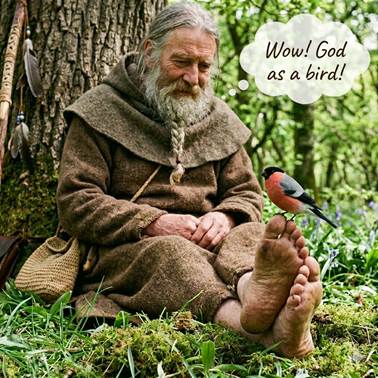
The druid said: “Wow! It’s a
bird!”
1. Surface Description Old Finn,
the druid, sits barefoot at the base of a tree in a lush woodland setting. His
posture is relaxed, contemplative. A bullfinch perches delicately on his
toes. A thought bubble above him reads: “Wow! God
as a bird!” The image
juxtaposes three elements: ·
A human emergent (the druid) ·
A non-human emergent (the bird) ·
A cognitive interpretation (“God as a bird”) The
humour and depth lie not in theology, but in ontology. 2. First Finnian Principle: God Is Not a Being In Finn’s
Procedure Monism, God is not an entity among entities. Therefore,
Finn is not thinking: “This
bird is a divine creature sent by a supernatural agent.” Rather,
it implies: “Here is
the universal procedure instantiated as bird.” The bird
is not symbolic of God. 3. Emergence and Localised Execution Under
Procedure Monism: ·
Reality occurs as quantised events. ·
Identity is bounded iteration. ·
Every emergent is a localised expression of the
universal constraint-as-rules system. The bird
exists because: ·
Energy has been constrained into a stable
biological pattern. ·
That pattern sustains itself through adaptive
iteration. ·
It is a temporary equilibrium of constrained
differentials. So when
Finn thinks: “God as a
bird” He is
recognising, realizing (as per Zen Kensho): The
universal procedure currently manifesting as this bounded, feathered
configuration. The bird
is not “other.” 4. The Realness Moment Realness
happens at contact. Here we
see a literal contact event: ·
Bird feet on human toes. ·
Skin meets claw. ·
Two emergent identities collide. This
contact is a point of high informational density. At that
moment: ·
The druid experiences “I AM.” ·
The bird experiences bird-specific awareness. ·
The universal procedure is executing twice in
mutual contact. The
druid’s exclamation expresses astonishment at that collision. 5. Why “Wow”? The “Wow”
is not theological awe. Consider
what is happening: A blind, rule-based,
non-sentient energy constraint grammar ·
Carbon chemistry ·
Evolutionary selection ·
A bird nervous system ·
A human nervous system ·
Mutual recognition ·
Self-aware interpretation From
simple constraint rules emerge: ·
Feathers ·
Toes ·
Consciousness ·
The interpretation “God” The
wonder is procedural compression. 6. The Bird as Equal Ontological Status In Finn’s
emergence = being understanding: There is
no hierarchy of sacredness. The bird
is not less divine than the druid. Both are: ·
Transient placeholders ·
Operational nodes ·
Constraint-sustaining modules “God as a
bird” is equally: ·
God as a druid ·
God as moss ·
God as photon ·
God as entropy gradient The
phrase equalises all emergents. 7. Collapse of Dualism The
thought bubble dismantles three classical dualisms (into monism): 1. Creator
vs creation 2. Sacred vs
mundane 3. Human vs
nature If God is
the procedure, Not
metaphorically. 8. The Subtle Irony There is
gentle humour in the image. The druid
is barefoot. Yet he
experiences cosmic realisation in a trivial moment. This
aligns with Finn’s reinterpretation of moksha: Liberation
is not escape from the world. The druid
is not transcending nature. 9. The Minimal Ontology Layer From
Finn’s Minimal Ontology: ·
Energy = directed or random action ·
Mass = confined (thus ordered) action ·
Realness emerges from random collision at c The bird
and the druid are confined action patterns. In that
event: The
universal procedure is locally self-aware. The
thought “God as a bird” is the procedure reflecting on its own output. 10. Final Finnian Compression Finn’s
logic reduces to this: 1. God =
universal generative constraint system. 2. The bird
is a bounded execution of that system. 3. The druid
is another bounded execution. 4. Their
contact generates a spike of realness and identity. 5. Recognition
occurs. 6. The
procedure recognises itself. Thus: “Wow! God as a bird!” means: The universal procedure is currently instantiated
as this feathered equilibrium in contact with this human equilibrium. And that
simple fact — and the
sense of being real and identifiable within the vast ocean of random momenta
— is
utterly astonishing, awesome and cause of ecstatic joy. |