|
“Emergence
as Divinity A Unified Theory of Brahman, Trivarga, and the Two Liberations” By Bodhangkur Sadhu 1. Introduction Classical
Vedānta distinguishes between: ·
Nirguṇa Brahman – the attributeless, undifferentiated absolute, and ·
Saguṇa Brahman – the
same absolute qualified by attributes, manifest as Īśvara
and the world of names and forms (nāma–rūpa). It also
recognises Trivarga—dharma, artha, kāma—as three
central aims of embodied life, and mokṣa
as the ultimate liberation from saṃsāra. Finn’s Procedure
Monism and Minimal Ontology re-interpret this terrain in rigorously
structural terms: there is only a single universal procedure that
iterates, constrains, and differentiates itself into emergents,
each emergent being a localised “consciousness bite” of this
procedure. This
essay integrates both frameworks by: 1. Identifying
Nirguṇa Brahman with Finn’s Universal
Procedure (UP). 2. Identifying
Saguṇa Brahman / saṃsāra with the totality and stream of
emergents. 3. Interpreting
each emergent as “localised Brahman-in-execution.” 4. Reinterpreting
the Trivarga as the optimisation strategy of
emergent Brahman. 5. Distinguishing
two mokṣas: o Mokṣa 1 –
liberation into optimal emergent life (perfection of the Trivarga). o Mokṣa 2 –
liberation from emergent life back into Nirguṇa
Brahman. The
result is a Vedantic theory where Brahman is not merely the static substratum
of the world but a quantised, procedural, self-experiencing absolute. 2. Nirguṇa Brahman as
Universal Procedure 2.1 Classical Vedantic Characterisation In
classical
Advaita (but not Ekatva) Vedānta, Nirguṇa
Brahman is: ·
Non-dual (advaya)
– no second entity exists. ·
Attributeless (nirguṇa) – beyond all qualifying predicates. ·
Unchanging (kūṭastha)
– not subject to time, space, or causation. ·
sat-cit-ānanda – being, consciousness, and
bliss in a non-separable unity. Nirguṇa Brahman is “beyond”
empirical description; it is the condition of possibility of all
experience, not a content within it. 2.2 Procedural Reinterpretation Finn’s Universal
Procedure (UP) can be read as a modern, systems-theoretic restatement of
this Nirguṇa Brahman: ·
It is one: there is no second procedure
running in another ontological space. ·
It is non-substantial: not a “thing” but ongoing
rule-governed iteration. ·
It is structural rather than qualitative:
its “nature” is the capacity to generate and sustain lawful sequences of
events. ·
It is pre-phenomenal: before any particular emergent appears, the UP is already there as
the background capacity for emergence. Thus: Nirguṇa Brahman
= the universal, self-consistent capacity-to-iterate In this
mode, Brahman is not yet “world” or “God” in the devotional sense; it is pure
potentiality of ordered manifestation. 3. Saguṇa Brahman / Saṃsāra as Totality and Stream of Emergent
Brahman 3.1 From UP to Emergence Procedure
Monism asserts that: ·
All “things” are patterns of constrained
iteration of the UP. ·
Constraint patterns yield emergents—relatively
stable, identifiable units (atoms, cells, organisms, stars, persons). ·
Realness is tied to identifiability: the
capacity to be addressed, tracked, and to participate in interactions. In
Vedantic terms: ·
Constraints and patterns correspond to upādhis (limiting adjuncts). ·
Emergent multiplicity corresponds to nāma–rūpa. ·
The UP modulated by upādhis
is precisely Saguṇa Brahman. Thus: Saguṇa Brahman
= Nirguṇa Brahman under constraint, 3.2 Saṃsāra as
Brahman’s Stream of Localised Manifestations Saṃsāra is then the temporal
procession of emergents: ·
births and deaths of stars, ·
formation and extinction of species, ·
lives and deaths of individual organisms, ·
arising and decaying of social structures and
cultures, etc. Each of
these is a localised run of the UP, i.e. Brahman-in-operation under
a specific constraint-envelope. Hence: Saṃsāra is not
outside Brahman; it is Brahman serially expressing itself as emergent
sequences. 4. Every Emergent as Localised Brahman-in-Execution 4.1 Identifiability and Emergent Reality Finn’s
criterion for realness: ·
An entity is real precisely to the extent that it
is identifiable and interaction-capable. Formally,
an emergent 1. Dynamic
closure – it maintains a recognisable pattern over time. 2. Boundary – it can
be distinguished from its environment. 3. Causal
coherence – its parts covary in systematically constrained ways. 4. Feedback
capacity – it can participate in action–reaction chains. This
applies from elementary particles (with stable quantum numbers) to organisms
(with metabolic closure and responsive behaviour), and up to persons and
societies (with narrative identity and institutional stability). 4.2 The Logical Step: No Second Ontic Source If there
is only one Universal Procedure / Nirguṇa
Brahman, then: 1. Every
emergent 2. There is
no ontological space for a second kind of “stuff.” 3. Therefore,
each emergent just is Brahman under a particular set of constraints. So, each
emergent is: Brahman-in-execution,
locally instantiated. The
classical formula “Brahman appears as jīva
through upādhi” is given a new precision: ·
upādhi = tight
constraint pattern ·
jīva = the
identifiable, feedback-capable emergent produced by this pattern Consequently: Every
emergent is a localised mode of Saguṇa
Brahman, which is itself Nirguṇa Brahman
constrained. There is
no metaphysical residue beyond this interplay of unconstrained capacity
and constrained execution. 5. Consciousness Bites: Brahman’s Distributed
Experience 5.1 Re-reading sat-cit-ānanda Procedurally Finn’s
reinterpretation: ·
sat – baseline realness: to be
= to be a stable pattern of constrained iteration. ·
cit –
baseline experiential presence: any emergent with feedback has a minimal
“for-itself” aspect (it differentiates states in ways that matter to its
persistence). ·
ānanda –
affective feedback: surplus-energy release upon successful
constraint-management (pleasure, joy), versus deficit and friction (pain,
suffering). In
Vedantic language this yields: ·
Every emergent shares
sat because its identifiability is grounded in Brahman’s
being. ·
Every emergent partakes in cit in
proportion to its feedback richness (a bacterium less than a mammal, a mammal
less than a reflective human). ·
Every emergent receives ānanda-signals as
localised pleasure/pain corresponding to its optimisation successes or
failures. 5.2 Consciousness as Distributed Interface Activity of
Brahman We can
then define: ·
A consciousness bite = the totality of
state-updates and feedback within a given emergent over a finite interval. The
universe at any moment is a superposition of countless consciousness bites: ·
the photon interacting with an electron, ·
the plant adjusting to light and moisture, ·
the animal evaluating threat and opportunity, ·
the human reflecting, planning, despairing,
rejoicing. Because
all emergents are Brahman under constraint, these
are: Brahman’s
own local experiences. Thus: The
totality of emergent experience—saṃsāra—is
Brahman’s distributed consciousness, a multi-centric, quantised stream of
“Brahman-events.” This
reframes the Upaniṣadic motif “Brahman wishes
to become many to enjoy itself” as a procedural axiom rather than a
mythic narrative. 6. Trivarga as Emergent
Optimisation of Saguṇa Brahman 6.1 Classical Trivarga Traditionally,
Trivarga comprises: 1. Dharma –
normative order, righteousness, role-appropriate conduct. 2. Artha –
acquisition of material means and power to sustain life. 3. Kāma – pursuit of pleasurable
experiences and emotional fulfilment. These are
puruṣārthas—legitimate aims of
human existence—typically placed below mokṣa
as the final ideal. 6.2 Procedural Reinterpretation In
procedural–Vedantic terms, Trivarga becomes the optimisation
algorithm of emergent Brahman: ·
Dharma as structural coherence ·
Artha as resource adequacy ·
Kāma as
affective guidance From a
systems viewpoint: Trivarga is how Saguṇa
Brahman keeps its emergents viable and adaptive
within saṃsāra. The worm
optimising for soil, the robin optimising for food, and the human optimising
for social and intellectual flourishing are all instances of Trivarga in execution. ·
The worm’s “dharma” is soil-tunnelling and
nutrient cycling; ·
its “artha” is
sufficient moisture and organic matter; ·
its “kāma” is
whatever local satisfaction corresponds to nutrient acquisition and avoidance
of lethal conditions. The same
structure scales up: ·
For a human, dharma includes ethical roles,
social obligations, self-consistency; ·
artha includes
economic security, health, education; ·
kāma includes
a wide range of pleasures from sensual to aesthetic to relational. 6.3 Perfection of Trivarga as
Mokṣa 1 If Trivarga is the optimisation engine of emergent Brahman,
its perfection occurs when: 1. Dharma attains
maximal systemic coherence – the emergent is internally and relationally
well-ordered. 2. Artha reaches
sufficiency and robustness – the emergent has the resources and capacities
necessary to sustain and develop its pattern. 3. Kāma becomes refined and
integrated – pleasure/pain feedback aligns with long-term viability and not
just short-term impulses. At this
point: The
emergent realises its full potential within its constraint-envelope. This
state is not mere comfort; it is structural excellence. In Vedantic
language: The
perfected Trivarga is Saguṇa
Brahman flourishing. Finn’s
key proposal is to call this first liberation: Mokṣa 1 = liberation of Nirguṇa Brahman into optimal emergent form via
perfected Trivarga. Here
Brahman is “free” not by escaping form, but by realising the fullest
richness of form. The high cost is the ever-present vulnerability to
pain; the high benefit is the depth and variety of joy made possible by fully
engaged existence. 7. Two Mokṣas: Into
Form and From Form 7.1 Mokṣa 1 –
Liberation into Optimal Emergent Life We can
now define Mokṣa 1 precisely: ·
Ontologically: the transition from
indeterminate Nirguṇa potentiality to richly
structured Saguṇa emergence. ·
Functionally: the achievement of
perfected Trivarga for a given emergent pattern. ·
Phenomenologically: the
full spectrum of experience—pleasure and pain—associated with living out that
pattern to its highest degree of coherence. Mokṣa 1 is liberation into saṃsāra, not from it. It is the creative,
expressive yes of Brahman to identifiable reality. The robin
that flies, mates, builds, sings, hunts, and dies in a life where dharma, artha, kāma have been well
balanced is an instance of Mokṣa 1 at avian
scale. A human life in which one’s capacities, relationships, and projects
have attained similar coherence is a human-scale Mokṣa
1. 7.2 Mokṣa 2 –
Liberation from Emergent Life Classical
Vedānta’s mokṣa
corresponds to a second, structurally distinct liberation: Mokṣa 2. Here: ·
Saguṇa Brahman
withdraws from the field of constraints. ·
Names and forms are seen as provisional and
ultimately relinquished. ·
The Trivarga is
transcended rather than perfected. ·
Pleasure and pain alike dissolve as the basis for
preferential differentiation ceases. Formally: Mokṣa 2 = return of emergent
Brahman to Nirguṇa Brahman, This is
the Ramana-Buddha direction: the rollback of “I am this” to “I am,”
and ultimately to the “am-ness” of Brahman without second. 7.3 The Full Brahman-Cycle We now
see a full “Brahman-cycle”: 1. Nirguṇa → Saguṇa (Mokṣa 1) 2. Saguṇa → Nirguṇa (Mokṣa 2) Both are
authentically liberations, but in opposite directions: one into
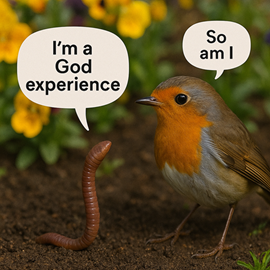
becoming, the other out of becoming. 8. Illustrative Examples 8.1 The Earthworm and the Robin In Finn’s
image: an earthworm emerges from soil; a robin stands nearby, about to eat
it. Each declares: “I’m a God experience.” “So am I.”
Interpreted
in this framework: ·
Both worm and robin are localised Saguṇa Brahman: Brahman under radically
different constraint-patterns. ·
Each has its Trivarga: o The
worm’s dharma is soil-processing; artha involves
moisture and organic matter; kāma tracks
states conducive to continuation of this pattern. o The
robin’s dharma includes predation on worms; artha
is food, shelter, territory; kāma includes the
joy of flight, song, and successful hunting. Their
interaction—predator and prey—is a constraint conflict within Saguṇa Brahman. From the worm’s perspective this
may be catastrophic; from the robin’s it is deeply satisfying; from the
standpoint of the ecosystem it is stabilising; from
the standpoint of Nirguṇa Brahman it is one
among endlessly many consciousness bites. If both
organisms live out their patterns coherently, each achieves Mokṣa 1 at its own scale. Their
eventual dissolution (death) contributes to the ongoing cycling of forms and
the ever-available possibility of Mokṣa
2—the return to the non-emergent. 8.2 Human Life as Trivarga-to-Two-Mokṣas Consider
a human who: ·
Establishes a stable ethical orientation and
social role (dharma), ·
Achieves sufficient security, education, and
freedom to act (artha), ·
Experiences rich, integrated forms of pleasure (kāma) aligned with long-term flourishing. This life
approaches Mokṣa 1: Saguṇa Brahman, in human form, is well executed. If,
toward the end of life, this same person turns inward and undertakes serious
contemplative practice—loosening identification with body and role, observing
sensations and thoughts as transient, coming to rest in sheer awareness—then
another process begins: Mokṣa 2,
the gradual release from constraint-bound identity. Thus one and the same life can
illustrate both muktis: first as emergent
flourishing, then as emergent dissolution. 9. Objections and Clarifications 9.1 Does Mokṣa 1
trivialise traditional mokṣa? One may
object that calling perfected Trivarga “mokṣa” dilutes the radical transcendence intended (actually suggested) in
classical Vedānta. Response:
the point is not to replace traditional mokṣa
but to add an analytically distinct liberation—the liberation implicit
in Brahman’s own choice to manifest. Classical Vedānta
already speaks of Brahman freely appearing as the world; it simply does not
name this as a “mokṣa.” Finn’s framework
suggests we should: liberation into form is as real and structurally
important as liberation from form. 9.2 Are all experiences equally “Brahman’s experience,”
including ignorance and delusion? Yes, but
with a crucial distinction: ·
Ontologically, every experience is a real
Brahman-event (it occurs in the stream of Saguṇa
Brahman). ·
Epistemically, experiences differ in their model
accuracy (how well they track and respond to constraints). Illusions,
delusions, and ideologies are still Brahman’s experiences, but they
are low-fidelity consciousness bites whose local models misguide
emergent optimisation. They belong fully to Mokṣa
1’s risky field: emergence is high-benefit, high-error. 10. Conclusion We can
now summarise the central claims succinctly: 1. Nirguṇa Brahman is the Universal
Procedure: the single, non-dual capacity-to-iterate. 2. Saguṇa Brahman
/ saṃsāra is Nirguṇa Brahman under constraint: the totality and
stream of emergents. 3. Every
emergent is a localised execution of Brahman—a bounded,
identifiable “consciousness bite.” 4. Trivarga (dharma–artha–kāma) is the optimisation
algorithm of Saguṇa Brahman: the structural
means by which emergent Brahman sustains and enhances itself. 5. Mokṣa 1 is the
perfection of Trivarga: liberation into optimal
emergent life, where Brahman fully realises its form, accepting the high
cost of pain and high benefit of joy. 6. Mokṣa 2 is the
transcendence of Trivarga: liberation from
emergent life back into Nirguṇa Brahman,
where both pain and pleasure cease. In this
synthesis, Vedānta is not discarded but deepened:
Brahman is not only the absolute beyond the world; it is also the procedural
engine of the world, tasting itself in every worm, every robin, every
human, every star. The universe is not merely “inseparable from Brahman”; it
is Brahman in execution, discretised and distributed as emergent lives,
each one a momentary but fully real Brahman-experience.
|