|
The Sri Yantra of Fear Ramana Maharshi’s
Shrinking Experiment A Procedural Analysis of
Atma-Reduction as Escape from the Price of Life, by Bodhangkur 1. The Initial Scene: A Boy Confronts the Price of Life Ramana
Maharshi’s adolescent panic attack is the originary
moment of his entire doctrine. Finn’s reconstruction states the problem
plainly: Life has
a price. Faced
with this local distortion (to use Finn’s Procedure Monism), Ramana
performs a move that is ancient in India: In
classical Advaita language this endpoint is ātman,
defined negatively, non-demonstrably, and therefore maximally open—an empty
placeholder capable of bearing all projection. In Finn’s
terms: ātman = an undefined, hence
unbounded, placeholder variable, suitable for any stabilizing, fear-reducing
hypothesis. 2. The Sri Yantra as Procedural Model Triangles as Differential Iterations
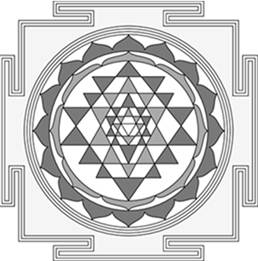
(Atma-Modifications) The Sri
Yantra is a perfect ancient map of this procedure.
·
The central bindu
is empty. ·
Around it triangles
proliferate—each a directional, differential complication of the centre. ·
These triangles are modulations: survival
adaptations, costs, distortions, tensions, desires, fears. In Finn’s language: Every triangle = an atma-modification
created for local survival. In Ramana’s hermeneutic, the Sri Yantra is inverted: 3. Ramana’s Strategy: Shrinking the World by
Shrinking the Data Whereas normal evolution increases differential
iterations (triangles) to successfully adapt, Ramana takes the opposite
route: 1. Fear
arises → he interprets it as a distortion. 2. All
distortions derive from the sense of being a localized agent (“I as
body,” “I as person,” etc.). 3. Therefore the solution is not
adaptation but subtraction: Hence his actual procedure is: Reduce local world → reduce meaning →
reduce relations → reduce identity → reduce distortion →
reduce fear. Practically, this takes the form of: ·
Withdrawing from social life ·
Entering trances that approach coma ·
Eliminating semantically-loaded
stimuli ·
Focussing obsessive attention on the atma placeholder ("I-I") ·
Severing all differential tasks required for
survival He shrinks the Sri Yantra operational domain until all
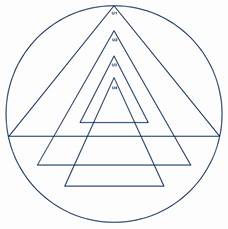
triangles collapse into one—the final triangle of pure “I am.” 4. The Final Triangle: The Absolute “I am” as
Zero-Distortion Atma Once only the first triangle
remains—representing the most minimal differentiation needed to sustain any
experience—Ramana takes the final step: ·
The triangle collapses into the bindu. ·
The procedural world is suspended. ·
What remains is the pure, undistorted
self-reference experience: In Ramana’s own later language, this is “the Self,”
“pure consciousness,” “Brahman beyond attributes.” In Finn’s reconstruction, this is: The final iteration before zero— Ramana absolutizes this state, interpreting it as the real,
the eternal, the unconditioned. 5. From Finn’s Procedure Monism: What Actually
Happened? Using Finn’s terminology: ·
Fear = a local survival prompt ·
Triangle-modifications =
differential survival iterations ·
Withdrawing from triangles =
suspending survival vocation ·
Final triangle (“I am”) =
minimal baseline experience (sat+cit) ·
Bindu = the placeholder, i.e.,
empty variable, not a metaphysical entity ·
Experience of the bindu =
self-hypnotic stabilization via extreme attention collapse From this perspective: Ramana’s experience is not discovery, but reduction: Life = differential complexity. Ramana’s “Brahman” is thus: ·
free of fear because ·
free of survival because ·
free of life. This is why his state resembles: ·
coma-like withdrawal ·
maximal concentration collapse ·
dissociation interpreted through Advaita
vocabulary ·
affect-free cognition Advaita then retrofits this as a universal metaphysical
truth. 6. Why Ramana’s Goal Is Not the Goal of Life
(Finn’s Critique) In Procedure Monism: ·
Every being exists as differential iterations
(“triangles”). ·
Every distortion is functional. ·
Fear is the price of life: the cost of
navigating uncertainty. ·
Removing distortions removes the being. Thus the Ramana-procedure is a procedure
of life-reduction, not liberation in the evolutionary sense. Finn’s conclusion: Ramana sought to eliminate the price of life by
eliminating life’s differential content. This is why Ramana became a symbol, a presence,
but not a participant in complexity. 7. Final Synthesis: Ramana as Sri-Yantra
Regression ·
The Sri Yantra maps the outward expansion of
survival iterations. ·
Ramana maps their inward reversal. ·
His “Self-realization” is the collapse of all
triangles into the final recognition of the undistorted placeholder “I am.” ·
Advaita interprets this as eternal truth; Finn
interprets it as a procedural simplification experiment, triggered by
fear, stabilized by obsessive concentration, absolutized by metaphysical
projection. Thus: Ramana did not discover the Self. |