|
The
Bridge that automatically and blindly builds its builder A Procedure Monism reading
of a “druid on a bridge” image as an identifiable reality self-bootstrapping
emergence diagram By the druid Finn Abstract This
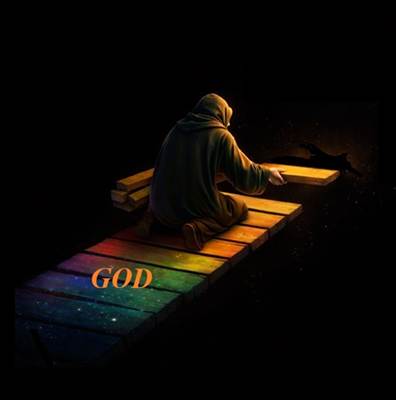
essay reframes a stylised image—an old, hooded druid kneeling on a plank
bridge extending into darkness, with “GOD” written on a coloured section—not
as narrative illustration but as an abstract ontological diagram. Under the
druid’s Procedure
Monism, the image models how any identifiable reality emerges
from a constrained (i.e. ruled) field of
random momenta by a Münchhausen self-bootstrapping
operation: the bridge and the druid co-emerge as a single internal, recursive
elaboration of constraint-stabilised collisions. “GOD” names not an external
being or foundation but the runtime experience of being a real
identifiable token—bridge + druid—generated and maintained by rule-bounded
interaction within the same field.
1. The methodological key: treat the image as diagram,
not story Most
viewers read the picture as a little myth: a person builds a bridge into the
void, guided by “God.” Procedure Monism forbids that reading. It insists that images of
agency are usually narrative cosmetics laid over a more primary logic: how
tokens become real and identifiable at all. So the proper method is to
strip the scene down to its procedural variables: ·
Field (darkness): a space of
random momenta / unconstrained degrees of freedom. ·
Constraint (planks/bridge): stabilised
rule-bounded structure. ·
Token (druid): a higher-order
stabilisation that can reflect, predict, and elaborate constraint. ·
Iteration (the next plank): the next
discrete emergence event—always variant, never identical repetition. ·
Experience label (“GOD”):
the felt fact of being a held-together instance of reality. Under
this reading, the “entertaining cosmetics” (hood, posture, colours) do not
invalidate the diagram; they make a severe abstraction tolerable to the human
nervous system. The diagram is still doing hard metaphysical work. 2. The ontological claim encoded: bridge + druid
co-emerge The
decisive Procedure
Monism statement is: The druid is an elaboration of the bridge. This
collapses the apparent dualism “builder vs built.” The druid is not outside
the system laying boards onto reality; he is a higher-order product of the
same constraint dynamics the boards exemplify. 2.1 Münchhausen emergence:
self pulls self into being The
picture encodes a self-bootstrapping loop: 1. A minimal
stabilisation occurs (a “plank” holds). 2. That
stabilisation becomes a platform that enables further stabilisations. 3. Iteration
produces a higher-order stabilisation (the “druid”), which is not external
agency but internal meta-function. 4. That
meta-function feeds back into the system by selecting, arranging, or biasing
subsequent stabilisations. 5. The whole
becomes more stable by using its own stability as leverage. This is Münchhausen-style: the system appears to “pull itself up
by its own hair,” but what’s actually happening is a
recursively accumulating constraint network. The image captures this because
the druid kneels only where planks already hold, yet his presence suggests
increased elaboration. He is both result and operator—but the operator is
internal, not transcendent. Example: language as bridge and speaker A clean
example is language. There is no “speaker” outside language who constructs
language. Rather: ·
proto-sounds
stabilise into repeatable signals, ·
signals stabilise into grammar, ·
grammar stabilises into “speakerhood”—a
self-model capable of meta-control, ·
the “speaker” then reshapes language—but only as
a function produced by language. Speaker
is to language what druid is to bridge: a late-stage constraint elaboration
that becomes feedback. 3. Randomness without teleology: the next plank must
differ A bridge
image tempts teleology: “he’s going somewhere.” Procedure Monism refuses
this. The bridge is always ‘there’, arrived. The crucial clarification is: The next
plank must be random (i.e., different). Here
“random” means: not deducible in detail from the
previous plank, not identical repetition, not a linear plan; it is a fresh
local resolution of constrained degrees of freedom. In PM, a
stable token is not produced by a pre-written blueprint. It is produced by: ·
a constrained field that permits some
stabilisations, ·
selection by survival (what holds persists), ·
differentiation by local contingencies (no
iteration identical). 3.1 The “bridge” is not a path; it is a history of
successful stabilisations So
“bridge” is a misleading everyday word. The diagram’s bridge really means: ·
a sequence of discrete successful constraints, ·
retrospectively interpretable as a continuity, ·
but ontologically composed of non-identical
events. Continuity
is the aftereffect of serial success, not a primitive substrate. Example: evolution without destination Biological
evolution “looks like” it is heading toward intelligence. But PM reads
intelligence as one contingency among many. The “planks” are successful
adaptations. There is no final shore. The bridge is just the visible trace of
what happened not to fail—until it does. The bridge is the shore! (changing with every plank!) 4. Colour as elaboration variance, not moral value The
image’s rainbow boards are easily moralised (“goodness,” “sacredness”). Procedure Monism blocks
that move. The colours can be read strictly procedurally: ·
Each plank is functionally a stabilisation
(it holds). ·
Each plank is formally different (a fresh
iteration). ·
Colour is a shorthand for non-identical
elaboration. In PM terms,
the colours represent “variant tokenhood” rather than
value hierarchy. The cosmetics are therefore conceptually apt: they visualise
differentiation without importing metaphysical good/evil. Example: engineering tolerances Two bolts
can be “the same” in a design sense while being microscopically different.
Functionally equivalent, ontologically variant. Colour is the image’s way of
insisting: sameness is an operational category, not an ontological one. 5. The entire content is internal to the constrained
field A further
crucial assumption: darkness is not “outside the system.” The entire scene is
internal to the same field-space. This
matters because it eliminates every residual transcendence: ·
The “void” is not supernatural nothingness. ·
It is the unconstrained remainder: degrees of
freedom not yet stabilised as tokens. So bridge, druid, colours, and
the act of “placing” are all internal dynamics of one field under constraints
(as rules set). No external ground. No
outside vantage point. 5.1 Reality is not inserted into a container; it is the
container’s self-localisation In PM language:
the field does not contain reality as an object; rather, “reality” is what
the field does when constrained into stable collisions. Example: phase transitions In
physics, a phase transition (e.g., gas → liquid) is not an external agent
forcing matter into form. It’s the system reconfiguring under constraint
parameters (temperature, pressure). The “form” is internal, not imposed. 6. Collision is the generator of realness The central
druidic Procedure
Monsism sentence is: The
bridge (+ druid) becomes real by colliding, interacting with itself. This is
the most ontologically stringent claim in the entire interpretation. “Real”
here means: identifiable, bounded, stable enough to
be operational. Under Procedure Monism, that requires
collision/interaction: ·
Without interaction, there is no measurement, no
boundary, no identity. ·
Identity is not “in” a thing; it is the persistence
of a constraint pattern under repeated interaction. The
bridge therefore symbolises not material boards, but iterated
self-interaction: constraint meeting momentum, again
and again, yielding stable recognisable structure. Example: the self as collision loop A self (such as an ‘atman;) is not a ghost in a skull.
It is a stable control loop: perception meets action; action meets feedback;
feedback shapes constraint. The “I” is a maintained boundary-condition, not
an essence (as already the Buddha claimed). 7. The subtle brilliance: the next plank is placed
before it collides A further
deep technical nuance is added: The next
plank is placed before it can collide; only later does it become fully real. This
encodes the fact that emergence is always slightly ahead of its own
confirmation. Systems “propose” structures—then selection/collision tests
them. So emergence proceeds as: 1. Speculative
placement (a candidate structure arises). 2. Collision
testing (interaction confirms or destroys it). 3. Stabilisation (if it
holds, it becomes part of the path). This is profoundly
aligned with PM’s view of
living intelligence: organisms (and cultures) are not passive; they
continuously place “next planks” (predictions, actions, hypotheses) into the
field and let reality’s collisions (to wit, natural ‘self’-selection) decide. Example: predictive processing Brains
act as inference machines: they generate predictions first, then update by
error signals. “Plank placed before collision” is a visual metaphor for
prediction-first cognition—except in your PM register, it is a universal
mechanism, not just neural 8. “GOD” as the runtime experience of being an
identifiable reality Finally,
the word “GOD” in the image is the most misread element—and the most
important. Under the
druid’s formulation: GOD
(experience) is the bridge (+ druid) experience as identifiable reality. So GOD is not a being. GOD is
not an external foundation. GOD is not the first plank. GOD is: ·
the felt
fact of tokenhood, ·
the experience of “being held together,” ·
the reflexive awareness that an iteration is
occurring as this. In short: GOD =
the phenomenology of successful constraint. This
dovetails cleanly with the druid’s minim: “I AM the God experience.” The “I
AM” is not ego inflation; it is the procedural signature of a bounded runtime
instance. Example: ordinary “is-ness” without theology Strip
theology away and you still have an irreducible datum: there is something
it is like to be this stabilised process. The GOD label names that real, identifiable
datum, not a metaphysical person. 9. Critique: where the image can still mislead (and how
to defend it) Even if
the diagram is internally correct, it remains externally vulnerable to
misreading. The main risk is not metaphysical error but audience inference: 1. It looks
like external agency (a builder). 2. It looks
like destination (a bridge). 3. It looks
like sacred foundation (GOD label + colour). The druid’s
defence is precisely his interpretive rule: the scene is internal and self-bootstrapping;
druid is bridge elaboration; randomness blocks teleology; colour marks
variance. To make
the diagram more robust for outsiders, the druid could (optionally) tweak the
artwork so that: ·
the “placing” looks like a snap-into-place
collision effect rather than carpentry, ·
the druid looks less like a separate person and
more like a condensation/vortex of the same plank-logic, ·
“GOD” appears as a field overlay (an experiential
glow) rather than text on a board. But as a
private Finnian emblem, its very mis-readability is
part of its utility: it lets a severe abstraction be carried inside a
culturally familiar skin. Conclusion: not a story, a schematic wearing a cloak Under Procedure Monism, the
image is a legitimate compressed ontology: ·
A constrained field of random momenta generates
stabilisations (planks). ·
Stabilisations accumulate into a history of held
collisions (bridge). ·
The bridge elaborates internally into a
meta-function (druid). ·
The meta-function feeds back, proposing new
stabilisations (next plank) that are then collision-tested. ·
The felt fact of being this bounded, identifiable
runtime instance is the “GOD experience.” So the image does not depict a
druid building a bridge toward God. It
depicts: Procedure
iterating itself as bridge and druid, Or in the
strict druid register: No
carpenter. |