|
From Quantum Confinement to Human Waveforms By the druid Finn
1. Quantum confinement: randomness forced into form At the base
of physical reality, momentum is not orderly. In quantum mechanics,
unconstrained (meaning random) energy (momenta) expresses as probabilistic
motion — a spread of possible positions, phases, and momenta. A bound quantum
or particle is described not as a point, but as a wavefunction: a distributed
set of possibilities. The
moment confinement is introduced — a potential wall, a boundary, a trap, a
lattice — randomness is forced to negotiate with constraint (i.e. rule). This
produces: ·
Standing waves ·
Quantized energy levels ·
Discrete modes of oscillation The bound
quantum is no longer “anything anywhere.” Confinement
does not eliminate randomness. Form is
frozen probability. 2. Nested confinement: complexity from recursion Nature
does not stop at one boundary. Confinements
stack: ·
Electron in atom ·
Atom in molecule ·
Molecule in cell ·
Cell in tissue ·
Tissue in organism ·
Organism in environment ·
Environment in culture ·
Culture in language ·
Language in self-model Each
layer is a new potential wall. Each
wall: ·
Filters momentum ·
Selects modes ·
Creates resonances ·
Suppresses some frequencies ·
Amplifies others What
results is not a single wave — but a nested interference pattern of many
waves. Identity
is not added. A human
is not free randomness. 3. The human as Schrödinger object Schrödinger’s
equation is not about particles/things per se. In this
sense, a human is a Schrödinger object: ·
A standing wave in a biological wall ·
A resonance pattern in a genetic cavity ·
A solution to ecological boundary conditions ·
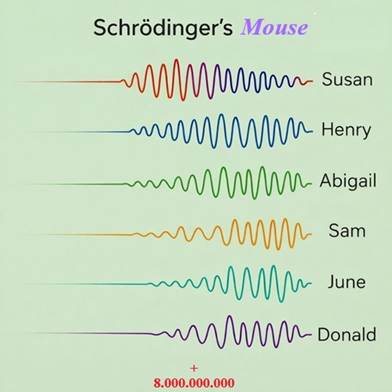
A long-lived eigen-state of nested constraints An image
is a compressed visualization of that fact. Each
named person is represented as: A
stabilized interference pattern of constrained momentum. Not
essence. A human
is what a universe-wide wave looks like when trapped within a mammal-shaped
wall (of constraints/rules). 4. Why the waves thin on the left and complex near the
name The thin,
simple left tail corresponds to: ·
Low information ·
Minimal confinement ·
Broad, undifferentiated possibility This is
raw energy before deep structuring (hence
mass). As the
wave moves right, toward the name: ·
Boundaries accumulate ·
Frequencies multiply ·
Interference increases ·
Phase relationships densify Complexity
is not decoration. The name
marks the deepest confinement: Social The
“person” is the most constrained region of the wave. A name is
a boundary condition (that
identifies). 5. Why each wave is different All
humans are made of the same physics. Different: ·
Genes ·
Developmental noise ·
Micro-traumas ·
Learning paths ·
Social phase-locks ·
Cultural potentials ·
Feedback loops So each
wave has: ·
Different harmonics ·
Different damping ·
Different resonance clusters They are
all Schrödinger equations. Not
different kinds of thing. 6. Logic compression of the image The image
is not metaphorical. It says,
in one frame: A human is
a stabilized, named interference pattern of originally random momentum,
shaped by nested confinement across physics, chemistry, biology, and culture. Or more
brutally: A person
is what probability looks like after surviving enough walls = constraint
grids. 7. Finnian minim compression In Finn’s
register, the whole image reduces to something like: ·
A human is a trapped wave that learned its own
name. ·
Identity is probability that hit enough walls to
ring. ·
The human self is a standing wave in a
mammal-shaped cavity. ·
A person is not a thing — but a working data transduction
solution. 8. Why this aligns with Procedure Monism This fits
exactly with druid Procedure
Monism: ·
No substance added ·
No soul inserted ·
No metaphysical upgrade Just: Random action + constraint + recursion = identity. The
universe does not create people. An image (or real identity) is therefore not art in the
usual sense. It is a
diagram of how Nature writes biographies in wave mechanics. |