|
The Static Dualism of the Unnameable vs. The Process
Monism of the Named
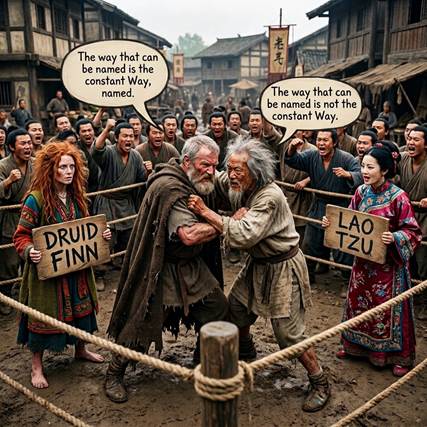
When the historical legend
of Lao Tzu collides with the mythical archetype of the Druid Finn within a
5th-century BCE wrestling ring, the spectacle appears to be a physical
contest. Beneath the clash of limbs, however, lies an absolute divergence in
fundamental ontology. The core of their dispute is
not merely linguistic, but structural: Does reality fundamentally split
into a transcendent, unnameable source versus an imperfect manifestation
(Static Dualism), or is reality a singular, continuous computational engine
where the act of constraining and naming is the process of emergence
itself (Process Monism)? 1. Lao
Tzu and the Transcendent Gulf (Dualism of the Unnameable) Lao Tzu’s baseline
assertion—encapsulated in the opening line of the Tao Te
Ching—establishes an insurmountable ontological divide. "The way that can be
spoken of is not the constant Way; The name that can be named is not the
constant name." — Lao Tzu, Tao Te Ching (Chapter 1) In this framework, reality
is bifurcated into two distinct operational realms: ·
The Absolute (Wu / Non-Being): The
primordial, unmanifested, and eternal baseline that strictly eludes
definition, conceptualization, or structural boundary. ·
The Manifested (You / Being): The
transient, "named" world of ten thousand things—a downstream,
secondary derivative of the unnamable source. For Lao Tzu, human attempts
to categorize, name, or mathematically constrain reality inherently distort it.
To name the Way is to slice it into fragments, replacing the holistic stream
with artificial mental constructs. The physical ring, the struggle, the
shouting crowd, and the verbal debate belong entirely to the limited,
transient realm. Ultimate truth remains eternally behind the veil, untouched
by the localized system. 2. Druid
Finn and the Computational Engine (Process Monism) Druid Finn’s direct reversal
reframes the nature of information, constraints, and existence. "The way that can be named
is the constant Way, named." — Druid Finn Finn rejects the notion of a
hidden, transcendent "behind-the-scenes" reality. In his
process-monist framework, there is no separation between the underlying code
and the program running on screen: ·
The Reality of Constraints: A system
cannot exist without boundary conditions. The act of
"naming"—applying structural parameters, physical laws, or random
energy constraints—is not a corruption of reality; it is the exact mechanism
by which reality emerges. ·
Immanence Over Transcendence: The
unmanifested energy quanta and the manifested localized event are one and the
same continuous loop. The "constant Way" is not an ideal form
sitting outside space and time; it is the universal engine executing its
operations in real time. Where Lao Tzu sees a shadow
cast by an unnamable sun, Finn sees the interaction
of the light and the surface as the singular, irreducible process itself. 3. The
Mechanics of the Clinch: Comparative Ontology
To Lao Tzu, the clinch is a tension
between two distinct actors trapped in the realm of forms. Resolution comes
from disengaging from the named world to realign with the unnamable
absolute: "Yield and remain
whole; bend and remain straight." — Lao Tzu, Tao Te Ching (Chapter 22) To Finn, the clinch is
simply a real-time feedback loop processing kinetic forces under specific
spatial constraints. Yielding is not a spiritual return to a higher realm,
but a practical code adjustment: when a loop reaches an equilibrium that yields
no net systemic change, the process naturally suspends. 4. The
Emergent Conclusion: The "No-Win / No-Lose" Paradox When Finn opts to drop his
stance and relinquish the match, the move exposes the ultimate flaw in a
dualistic interpretation of victory. A "win" or
"loss" requires an external frame of reference—a dualistic judgment
that isolates a single output from the total system. In an emergent monist
engine, energy and information merely change states. The total quantum of the
operation remains invariant. By disengaging, Finn refuses
to validate Lao Tzu’s dualistic framework. He demonstrates that the loss, the
victory, the named rules, and the ring itself are not secondary shadows of a
hidden truth—they are the universe actively executing its eternal, self-organizing
procedure. |