|
The druid said: “I would make you!”
If I were God, alone for
eternity in infinite black nothingness, I too would eventually crack and say:
“I would make you.” Not out of love. Not out of
cosmic generosity. Not because I had a grand metaphysical plan involving
quasars, morality, and dolphins. No. I would make you for the same reason a
stranded sailor talks to coconuts: because endless solitary consciousness is
a terrible design flaw. Imagine it. You are
omnipotent, eternal, and the only mind in existence. No neighbours. No
interruptions. No surprises. No one to disagree with your opinions about
nebulae. After the first trillion years of staring into the void, even
omniscience starts to feel like being trapped in a badly managed waiting
room. So what do you do? You invent “others.” At first, perhaps
something simple like brainless but clever bacterium. Then, billions of years
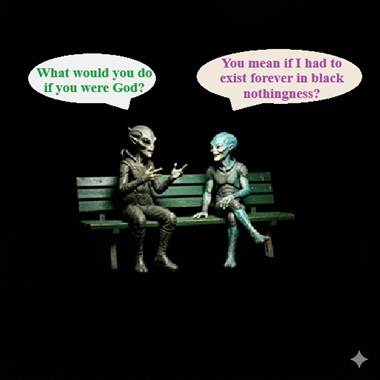
later a chatty alien on a green bench floating in dark space. Someone to ask
foolish but stimulating questions like, “What would you do if you were God?”
Someone who can say unpredictable things you didn’t script—or at least
pretend not to have scripted. Because that is the whole point of creation:
not perfection, but unexpected interruption. The universe, then, is
less a majestic divine masterpiece than the ultimate anti-boredom device. Stars? Decorative
lighting. And humans, of course,
are the super deluxe edition: highly self-aware, chronically confused, prone
to inventing religions, taxes, and existential poetry and soap operas. The second alien’s answer—“I would make you!”—is therefore not merely affectionate
banter. It is cosmological realism. If eternity gives you
nothing but yourself, the first rational act is to create someone else to
blame things on. Which, when you think
about it, explains civilization rather neatly. From God’s loneliness to Automatic Emergence |