|
The
Self-Transforming World and the Universal Procedure Guo Xiang compared with
Finn’s Procedure
Monism By Bodhangkur Mahathero
At first
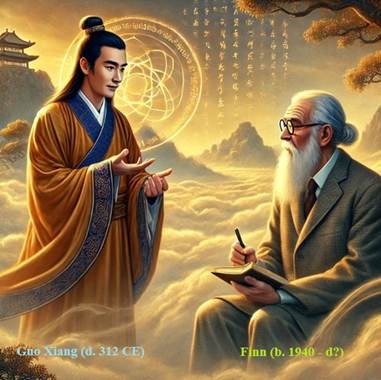
glance, Guo Xiang (d. 312 CE) and Finn (b. 1940 – d ?) appear astonishingly close. Both
reject transcendental metaphysics. Yet
beneath these similarities lies a profound structural divergence. Guo Xiang
describes spontaneous emergence. That
difference changes everything. 1. Guo Xiang: Self-Transformation Without Central
Mechanism Guo
Xiang’s core doctrine is zihua or duhua: things
transform spontaneously from themselves. Reality
is a ceaseless process of self-generation (i.e. an automaton) without
transcendent source, divine planner, or metaphysical substrate. Birds fly
because they are birds. Nothing
stands behind this process. This
produces an elegant radical immanentism: ·
no hidden absolute, ·
no creator, ·
no “other shore,” ·
no metaphysical beyond. Reality
is simply spontaneous transformation all the way down. But here
Finn’s critique begins. For Finn,
“spontaneous transformation” is descriptive, not explanatory. It says
that transformation occurs, but not why stable identities emerge repeatedly
instead of collapsing into total incoherence. Guo Xiang
brilliantly dissolves metaphysical substances but leaves procedural structure
underdefined. 2. Finn’s Procedure Monism:
Emergence Requires Constraints Finn
accepts Guo Xiang’s rejection of transcendental metaphysics but introduces a
missing mechanism: constraint. Procedure Monism argues that
emergence is not merely spontaneous. It is
procedurally constrained. Reality
consists of: ·
random energy fluctuation, ·
shaped by stable constraints, ·
generating coherent emergents.
Finn’s
universe resembles a universal computational process: ·
endless random input, ·
limited rule-set, ·
stable patterned outputs. This is
why Finn repeatedly invokes the Universal Turing Machine analogy. The key
question becomes: Why does
anything coherent exist at all? Guo Xiang
answers: because things
spontaneously self-transform. Finn
answers: because
one universal procedure continuously constrains random momentum into
temporary coherent identities. This is a
massive conceptual shift. Guo Xiang
privileges spontaneity. 3. The Missing Physics Guo Xiang
remains phenomenological. His
philosophy describes lived emergence beautifully but avoids hard ontological
mechanics. Finn
radicalizes the issue by grounding emergence in quantised interaction. For Finn: ·
discontinuity is fundamental, ·
contact generates realness, ·
identity emerges through repeated constrained
collisions, ·
existence is procedural stabilization. This
introduces an explicitly physicalized ontology absent in Guo Xiang. Guo Xiang’s
world flows. Finn’s
world computes. 4. Dao vs Universal Procedure Guo
Xiang’s Dao is ultimately elusive. Although
he strips it of creator-like transcendence, Dao still functions as a vaguely
holistic descriptor of spontaneous reality. Finn
rejects such vagueness. Procedure
Monism insists: if
something functions, its operation must be describable procedurally. Thus Finn
replaces Dao with: the
Universal Procedure (UP) The UP is
not mystical. It is: ·
blind, ·
automatic, (i.e. an automaton) ·
non-conscious, ·
constraint-based, ·
endlessly iterative. Guo
Xiang’s language remains poetic and fluid. Finn
operationalizes the cosmos. 5. Anti-Metaphysics Both
thinkers are deeply anti-metaphysical, but in different ways. Guo Xiang
dissolves metaphysics into immanence. Finn
attacks metaphysics as semantic fraud or cosmetic rendering. Guo Xiang
says: there is
no hidden world behind appearances. Finn
says: hidden
worlds are generated by cognitive and survival-driven abstraction systems. Thus
Finn’s critique is harsher. Guo Xiang
softens transcendence. 6. Identity Guo Xiang
treats identity as temporary situational expression within spontaneous
process. Finn
agrees but adds: identity
is generated through repeated procedural stabilization under constraint. Thus
Finn’s identity theory is more mechanistic. For Guo
Xiang, beings flourish by expressing their allotment naturally. For Finn,
beings are local coherent iterations of the same universal procedure. In Finn: every
emergent is “God in
its space.” But “God”
here means the UP locally
instantiated. This is
not present in Guo Xiang. 7. Consciousness Guo Xiang
never fully naturalizes consciousness. Finn
does. For Finn,
consciousness is: a
survival-oriented analog(ue)
rendering interface generated from underlying digital-like quantised
interactions. This is
radically modern. Consciousness
becomes dashboard simulation rather than mystical awareness. Guo Xiang
still inhabits contemplative phenomenology. Finn
converts cognition into procedural adaptation machinery. 8. “Beyond” and Transcendence Here the
two thinkers become unexpectedly close. Guo Xiang
strongly resists transcendental “other worlds.” Finn goes
further and calls such notions semantic or religious inflation. For Guo
Xiang: there is
no metaphysical beyond. For Finn: “beyond”
itself becomes a deceptive placeholder unless procedurally definable. Thus Finn
weaponizes Guo Xiang’s immanentism into outright anti-transcendental
critique. Final Difference The
deepest difference is this: Guo Xiang
describes the spontaneity of reality. Finn
explains reality as constrained procedural emergence. Guo Xiang
dissolves the metaphysical absolute. Finn
replaces it with operational structure. Guo Xiang
leaves mystery intact. Finn
attempts to compress mystery into mechanics. Or in one
sentence: Guo Xiang describes a self-flowing cosmos; Finn describes a self-computing cosmos. A
comprehensive summary of Guo Xiang’s thought |