|
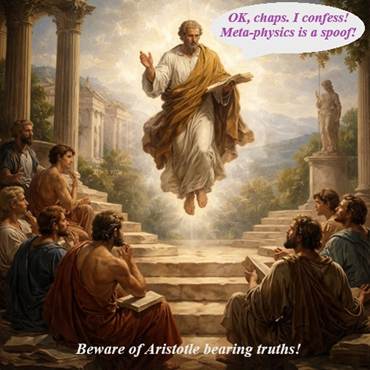
The druid said: “Metaphysics is a spoof!” A procedural critique of a disciplinary illusion By Victor Langheld
1. Introduction: From “After Physics” to “Beyond
Nothing” The term metaphysics
originates from Aristotle’s editorial history—literally “the books that come after
the Physics.” The druid
Finn’s proposition reframes this entirely: If “meta”
denotes a beyond (or after) that cannot be referenced, because essentially
apophatic, then metaphysics names not an extension of physics, but a failure
of reference disguised as an extension. The druid
develops that claim rigorously: metaphysics is a spoof on physics—a
structurally convincing imitation that removes the constraints that make
physics meaningful. 2. Physics: Constrained Contact with Reality Physics
is not defined by subject matter alone, but by methodological constraint: ·
It ties every term to observation or measurable
effect. ·
It encodes claims in mathematical form. ·
It exposes itself to falsification. ·
It produces predictions under specified
conditions. Physics
answers questions like: ·
How does a rock fall? ·
What measurable forces govern motion? As one
summary puts it: physics seeks to understand how phenomena behave. Its
defining feature is not explanation, but accountability. 3. Metaphysics: The Study of the Uncheckable By
contrast, metaphysics is traditionally defined as: ·
The study of “being,” “existence,” or “first
causes” ·
Inquiry into the “most general features of
reality” ·
Exploration of what lies beyond empirical
investigation It asks: ·
What does it mean to be a rock? ·
What is the ultimate ground of existence? But
crucially, these questions lack: ·
Measurable referents ·
Test conditions ·
Failure criteria Metaphysics
therefore operates without external constraint. Its only regulator is
internal coherence. 4. The Nullity of “Meta” The
druid’s decisive move is semantic: ·
“Meta” = beyond / after ·
But beyond what can be referenced is indistinguishable
from nothing, and as the druid said: “Isn’t ain’t!” Therefore: “Meta” is
a directional claim without a destination. It
signals transcendence without providing access. Once this
is accepted, metaphysics collapses structurally: Metaphysics
= physics + (meta = ∅) No
additional domain is reached. Only language continues. 5. The Spoof Mechanism Metaphysics
succeeds as a spoof through three mechanisms: (1) Semantic Mimicry It adopts
the tone of explanation—“ground,” “cause,” “necessity”—without operational
definitions. (2) Referential Deferral Terms
explain each other in loops: ·
Being → substance → essence →
ground (3) Immunity to Failure Because
no test conditions exist, metaphysical claims cannot be falsified. This
aligns with a known philosophical concern: metaphysical interpretations can
“float free from physics,” allowing multiple incompatible descriptions of the
same phenomena. 6. Worked Examples Example 1: Causation ·
Physics: ·
Metaphysics: The
second mimics explanation but adds no constraint. Example 2: Substance ·
Physics: describes matter/energy through
measurable properties ·
Metaphysics: posits “substance” as underlying
reality (so
Spinoza’s failure) But
“substance” is defined only through its role, not through observation. Example 3: Ultimate Reality ·
Physics: stops at current models (e.g., quantum
fields) ·
Metaphysics: posits “ultimate ground” beyond all
models But this
“ground” cannot be accessed, measured, or falsified. 7. Why the Spoof Persists Despite
its null referential content, metaphysics persists (as fig leaf) because
it performs functions physics cannot: ·
Closure: it answers questions
physics leaves open ·
Stability: it provides conceptual
anchors ·
Flexibility: it adapts to any framework
As some philosophers
note, metaphysics often overlaps with science conceptually but lacks its
empirical anchoring, raising doubts about its independent role. Its
survival is therefore functional, not epistemic. 8. Final Reduction The druid’s
proposition can now be stated with precision: Metaphysics
is a spoof on physics because it imitates explanatory form while removing
referential constraint. Or more
formally: ·
Physics = constrained, testable description of
observable reality ·
Metaphysics = unconstrained extension of language
beyond reference Thus: Metaphysics
= physics without friction It moves
freely because nothing resists it. 9. Conclusion Physics
ends where measurement, prediction, and falsifiability end. But if
“meta” refers to no accessible domain, then: ·
No new layer is reached ·
No deeper reality is described ·
No additional truth is gained Only the appearance
of depth remains. One
discipline builds models that can fail. That
asymmetry is not accidental. |