|
The Village and the Truth-Bearer A procedural analysis of
expulsion as an invariant survival algorithm By the druid Finn
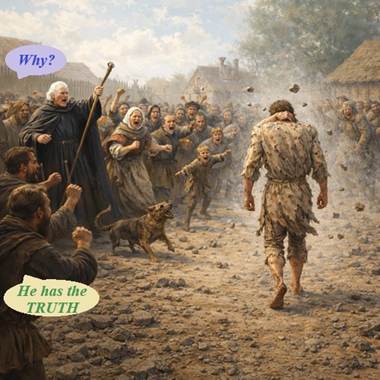
0. What the image is The image
is not “about” medieval cruelty, nor about disease, nor even about
Christianity in any doctrinal sense. It is a compressed diagram of a
recurrent procedure that appears wherever an emergent system must
preserve its operational identity under threat. In the
druid’s Procedure
Monism terms: the image is a snapshot of a whole token
(the village) executing a boundary-maintenance routine against a
perturbation (i.e. as update or structural reboot) that cannot be
metabolised. The perturbation is signified by two labels: ·
“Why?” = a destabilising query (a
crack in the local story) ·
“He has the TRUTH” = a
classification that justifies removal (a stabilising label) The
outcast man is not primarily a person. He is a carrier-state:
“truth-bearing” as (given) procedural
contamination. 1. The scene’s grammar: three actors, one real
protagonist 1.1 The crowd (the system’s distributed body) The crowd
is not a mob in the moral sense; it is the village functioning as an immune
system. Its anger, fists, and coordinated motion depict an emergent consensus
action. Key
diagnostic: there are children and a dog. ·
Children = the routine is inherited, not
reasoned. ·
Dog = the routine is instinctive and alignment-seeking. The image
insists: this is a species-level algorithm, not an ideology that
requires philosophers. 1.2 The authority figure (the system’s executive
interface) The
white-haired figure in the black robe with staff is the “API” between diffuse
impulse and authorised action. In many myths he is priest, elder, judge,
shaman, physician, official. His role
is not to invent the pattern but to: ·
legitimate it (“this is permitted”) ·
coordinate it (“now”) ·
symbolise it (“for the good of the
whole”) In Procedure Monism: he is a
meta-stabiliser—a local subroutine that reduces internal friction so
the whole can act as one. 1.3 The outcast (the perturbation with a vector) The
outcast’s posture is crucial. He is turned away, walking rightward. He is not
debating. He is not pleading. This removes sentimentality and makes the scene
formally legible: ·
He is a vector leaving the system ·
He is the waste-channel of the village The
village is “purifying” itself by exporting a problematic state. 1.4 The real protagonist: the boundary The real
protagonist is the boundary: fence line, village edge, inside/outside
distinction. The
boundary is not geometry; it is identity. ·
Inside = “we” ·
Outside = “not-we” ·
Crossing = the procedure by which “we” stays
coherent This is
why the scene is older than medieval art. It appears in nomad camps,
city-states, temples, tribes, and online communities. The architecture changes; the boundary function persists. 2. The two speech bubbles: the whole myth in two tokens 2.1 “Why?” — the rupture This
“Why?” is not directed to the outcast. It sits within the crowd, indicating
something much sharper: The
system contains an internal question it cannot answer without
destabilising itself. “Why?” is
what appears when: ·
the local narrative no longer fully explains the
local action, ·
but the action is still required for survival. In other
words, “Why?” is the symptom of a mismatch between: ·
felt necessity (we must expel) ·
available explanation (we
cannot say why without breaking the story) This is
an important invariant: systems rarely expel because they have perfect
reasons; they expel because they have non-negotiable pressures that
exceed their representational capacity. 2.2 “He has the TRUTH” — the containment label This
second bubble answers the first, but not by explaining. It answers by classifying. This is
the move every coherent system makes when it cannot integrate a destabilising
signal: ·
it turns an unassimilable content into a
removable container. “Truth”
here does not mean “correct proposition.” It means: An
invariant constraint made explicit inside a local, partial run. Truth is
dangerous not because it is wrong, but because it is complete in a way
the local run cannot tolerate. 3. Why “truth” behaves like disease in emergent systems The image
fuses two categories—disease and truth—because procedurally they share a
property: They are contagious
states that can propagate without asking permission. A
biological pathogen replicates within the host. A “truth” (in the druid’s sense)
replicates within the host narrative: ·
It reduces degrees of freedom. ·
It dissolves comforting fictions. ·
It collapses rhetorical options. A stable
local identity requires: ·
selective attention, ·
controlled ignorance, ·
narrative buffers, ·
timing. A truth
that is too direct removes buffers and timing. It forces the system to face
its generator—its constraints—too nakedly. So the village’s immune
response triggers. Not
because the village is evil. 4. Christ as the Christian variation of the same
algorithm The druid’s
notion reading is structurally exact: the Christian version is the outcast on
the cross with the claim “I am the truth.” In this
register, crucifixion is not about divine transaction but about local
coherence under threat: ·
A local system can tolerate prophets, teachers,
even miracle-workers. ·
What it cannot tolerate is an instance that says: That
collapses the protective gap between: ·
unknowable generator (constraint field) ·
local application (the lived, partial emergent) If the
generator is made fully explicit inside the application, the
application risks dissolving as an application. It becomes “swallowed up in
structure,” as the druid put it. So the system chooses the only
remaining action: Remove
the carrier of explicit invariance. The cross
is the village boundary made vertical. 5. The deep procedural claim which the druid makes He is not
saying “humans hate truth.” He is saying something sharper and, in Procedure Monism, more
fundamental: Identifiable
reality depends on a managed separation between local run and universal rule. If the
separation collapses, so does local identity. So the local system does what
any bounded emergent must do: ·
preserve its operational form, ·
defend its narrative membrane, ·
export destabilising invariance. This is
not morality. It is mechanics. 6. Examples across domains (same structure, new
costumes or cosmetics) 6.1 Scientific communities A
community can tolerate anomalies until anomalies threaten the organising
paradigm. When they do, the truth-bearer is often relabelled: ·
“crank,” “unserious,”
“dangerous,” “unfundable” 6.2 Families The
“identified patient” (the one who says what nobody says) often gets expelled
emotionally or literally: ·
“Why are you like this?” ·
“You’re ruining everything.” 6.3 Institutions Whistleblowers
are treated as traitors even when accurate: ·
The institution must preserve itself as an
institution. ·
Truth, if fully integrated, would require
structural reconfiguration. 6.4 Online communities Truth
behaves like infection: ·
a destabilising post, ·
a clarifying question (“Why?”), ·
the label (“troll,” “misinformation,” “bad
faith”), ·
expulsion (ban, block, pile-on). Again:
not because every ban is wrong, but because the procedure is
invariant. 7. The image’s most important hidden move: the crowd’s
self-justification loop Look
carefully at what the bubbles do. Without
them, the image is “violence.” The
village is shown producing two internal tokens: 1. a
destabiliser: Why? 2. a
stabiliser: He has the TRUTH This is
the loop: rupture
→ label → expulsion → restored coherence The label
does not resolve the rupture; it converts rupture into a reason to act. That is
ancient. That is political. That is religious. That is biological. 8. The druid’s Procedure Monism formulation The
invariant stated in the druid’s preferred terms: ·
The village is a whole iteration seeking
equilibrium. ·
The outcast is a state that threatens
equilibrium by making constraints explicit. ·
The authority figure is a meta-rule that
speeds convergence of the crowd into one action. ·
Expulsion is the ejection operator that
preserves the whole’s identity. A crisp
law-like compression: When an
emergent cannot metabolise an invariant constraint, it exports the
constraint-bearer. Or, in the
druid’s sharper phrasing: The
local, known application must defend itself from being annihilated in
structure without identifiable reality. 9. Druidic distillation The
village does not kill the man because he is wrong. |