|
The Universe as
Self-Experience Why
Every Emergent is God in Local Mode A Procedural Monist Theory of Distributed Divinity and
Consciousness By Bodhangkur Sadhu 1. Introduction This
essay develops, formalises, and critically assesses the claim that every
emergent, as identifiable reality, is localised God (the Universal Procedure,
UP) in execution, and that the universe as the totality of emergents functions as God’s consciousness stream,
each emergent constituting a “consciousness bite.” The aim
is not devotional but theoretical (and personally experiential). Within Procedure
Monism and Finn’s Minimal Ontology, “God” is not a transcendent
person or substance but a shorthand for the one, universally operative
procedure (as set
of constraints or rules) that
iterates all real identifiable events. The thesis can therefore be restated,
more neutrally but less vividly, as follows: Thesis
(UP-localisation): I will
proceed by (2) outlining the ontological framework, (3) defining emergents and identifiability, (4) presenting the
argument that each emergent is a localised UP-execution, (5) showing how this
yields a distributed model of divine consciousness, (6) comparing the result
with pantheism, panpsychism, and classical theism, (7) discussing
implications for identity and value, (8) addressing major objections
(especially evil, error, and illusion), and (9) concluding with a systematic
summary. 2. Ontological Framework: Procedure Monism and Minimal
Ontology 2.1 Procedure Monism Procedure
Monism asserts that: 1. There is
only one kind of ultimate entity: procedure—ongoing, rule =
constraint governed iteration. 2. What we
call “things” (particles, organisms, galaxies, persons) are stable
patterns (i.e.
structured masses) of such
procedures, not substances. 3. The
universe is thus a single, self-modifying (or modulating) process;
multiplicity arises from constraint-patterns within that one process. This is
not merely a metaphysical rebranding of (Spinoza’s) “substance.” Procedure is defined functionally: ·
It is iterative (it runs in discrete steps
or acts). ·
It is rule-structured (not arbitrary; each
state follows lawful transitions). ·
It is informational (each iteration
carries and transforms information). ·
It is self-consistent (it must maintain
some coherence to persist at all). To call
this single global process “God” is not a theological claim about a
person but a conceptual intensifier: the UP (i.e. Universal logic, hence cognizable set
generating Procedure) is that than which no more comprehensive procedure
can be conceived. 2.2 Minimal Ontology The druid
Finn’s Minimal Ontology replaces (undefined) substance metaphysics with a compressed set of
defined operational primitives: 1. Energy = directed
action (unconfined iteration, propagation). 2. Mass = confined
action (iteration trapped in stable loops). 3. 4. 5. Realness = collision/interaction
effect of action at or under these constraints. 6. Observer = local
interface where such realness is registered. In this
framework, “to be” is to be a pattern (or mass) of
constrained action that can collide, interact, and thus be observed (or
at least in principle observed). 3. Emergent, Constraint, and Identifiability 3.1 Emergent as Procedural Pattern An emergent
is a recurrent, relatively stable pattern of UP-iteration satisfying: 1. Dynamic
closure: it maintains itself as a pattern across multiple
iterations (e.g. an atom’s electron configuration, an organism’s metabolism). 2. Differential
profile: it is distinguishable from its environment (e.g.
different field values, membrane boundaries, behavioural signatures). 3. Causal
coherence: its parts co-vary in regular ways (e.g.
genes–phenotype, components–function). Thus an emergent is not a static
“thing” but a bundle of constraints that make some iterations (context dependent, so the
Buddha) more
likely than others and so create stability. 3.2 Identifiability Finn
makes identifiability (via quantization thus confinement) the
criterion of realness: An
emergent is real precisely to the extent that it can be cognised, addressed,
and interacted with as a whole unit (i.e. quantum). Identifiability
entails: 1. Quantisation: The
emergent appears as a discrete unit (e.g. this photon, this cell, this
person). 2. Boundary: There
is a meaningful inside/outside distinction (e.g. cellular membrane, social
identity markers). 3. Difference:
Sameness is compressed out. 4. Persistence: It
survives across enough iterations to be tracked. 5. Feedback
capacity: It can participate in action–reaction chains (it is
not inert). Without
identifiability there is no address, no interaction, no survival function,
hence no ontological weight in this scheme. 4. Why Every Emergent is Localised UP-Execution 4.1 No Emergent Beyond the UP Under
Procedure Monism, all action derives from the one UP. There is no
second source. Formally: 1. Let 2. Any
emergent 3. Therefore,
all iterations that constitute So
existential dependence is absolute: without UP, no emergent. 4.2 No Emergent Apart from the UP One might
imagine the UP as one “thing” and emergents as a
second kind of entity “made out of” the first. Finn’s Procedure Monism
rejects this. Emergence is not additional stuff; it is patterned behaviour
of UP itself. Analogy: ·
A melody is not a second substance besides sound;
it is sound in structure. ·
Likewise, an emergent is not a second substance
besides UP; it is UP under constraint. Thus: Emergent
= UP + constraint envelope. 4.3 Localisation as Constraint Profile “Localised
God-in-execution” means: ·
God (UP) is the underlying,
globally valid procedure. ·
Localisation is the specific
constraint profile that channels the UP into a recognisable emergent. Examples: 1. Photon: o Constraint:
null rest mass, fixed speed o Result:
the simplest propagating UP-iteration; a minimal “God-pulse.” 2. Hydrogen
atom: o Constraint:
one proton, one electron, quantised energy levels. o Result: a
stable, repeatable pattern (ground state, emission lines) = UP looping in a
closed configuration. 3. Bacterium: o Constraint:
cell membrane, metabolic cycles, genetic circuits. o Result: a
self-maintaining, sensing, acting configuration—UP as minimal survival
agent. 4. Human
person: o Constraint:
nervous system, body plan, social and linguistic embedding, autobiographical
memory. o Result: a
high-resolution interface through which the UP can map, model, and
modify environments. In each
case, no new ontic layer is introduced; instead, the UP is bent
into shape by local rules and boundary conditions. Hence the
core claim: Every
emergent just is the UP performing a particular constrained routine. 5. From Emergent to Consciousness Bite 5.1 Baseline Consciousness: sat–cit–ānanda Reinterpreted Under
Finn’s reinterpretation: ·
sat = baseline being (the mere
fact of realness). ·
cit =
baseline experiential presence (minimal phenomenal “there-ness” inherent to
any emergent that has feedback). ·
ānanda =
contingent, context-dependent feedback signal indicating diminished or
increased constraint (roughly: suffering vs. release / joy). Every
emergent that maintains itself has at least proto-cit:
it must “track” perturbations and respond. This tracking need not be
introspective; it is enough that the system differentiates states in
functionally relevant ways. 5.2 Consciousness as Distributed Interface Activity On this
view: Consciousness
is not a single continuous field but the aggregate of all local UP-interfaces
responding to their (unpredictable) constraint environment. Each
emergent is a local “viewpoint” of the UP, a procedural vertex
where actions converge and generate feedback. Define: ·
A consciousness bite = the totality of
state-updates and feedback at one emergent during a finite interval. The
universe at any moment is then: ·
A vast multitude of consciousness bites
occurring in parallel. ·
Over time, these bites form streams—for
instance, the life trajectory of an organism, or the stable behaviour of a
planetary system. 5.3 God’s Consciousness as the Totality of Bites If “God”
= the UP, then: 1. Every
consciousness bite is a UP-internal experience. 2. The total
set of all such bites is the UP’s global consciousness. 3. Thus, the
universe is God’s consciousness stream, not metaphorically but
structurally. God is
not a separate super-observer. God is the sum of all observing and
experienced states — from photon scattering to human reflection — because
all of them are UP-internal events. 6. Comparison with Other Views 6.1 Classical Theism Classical
theism posits: ·
A transcendent, personal God, ·
who creates a distinct universe ex nihilo, ·
and maintains it while remaining ontologically
separate. In
contrast: ·
Procedure Monism denies the creator/creation
split. There is only the UP, internally differentiating. ·
“Creation” is merely novel patterning of
procedure, not a separate act by an external agent. Result: No
ontological gap to be bridged by revelation, miracle, or intervention.
All is already God-in-execution. 6.2 Pantheism Pantheism
says: “Everything is God.” The
present view is formally close but adds two key refinements: 1. Procedural
rather than substantial: 2. Quantised
and discontinuous: Thus the doctrine is better
phrased as: Every
real pattern is a divine iteration; divinity is not a static being but an
ongoing doing. 6.3 Panpsychism Panpsychism
attributes mind-like properties to all fundamental entities. Procedure
Monism’s account is more austere: ·
It does not posit intrinsic “mental stuff” in
particles. ·
It derives all mind-like features from iterative
feedback and constraint navigation in UP-patterns, hence as emergent. So while the conclusion—“mind is everywhere”—can look panpsychist, the
explanatory path is different: no separate mental ingredient; only
procedural complexity. 6.4 Panentheism Panentheism
(“all in God, God in all”) is approximated structurally: ·
All emergents are in
the UP. ·
The UP is in all emergents,
as their enabling procedure. The
difference is that panentheism often retains a surplus divine dimension
beyond the world; Procedure Monism sees no remainder beyond the complete
set of all procedural iterations. 7. Identity, Value, and Original Goodness 7.1 Identity as Address In this
framework, identity is not a metaphysical ego but an address: ·
An emergent’s identity
= the structured location of its constraints within the UP (its
“coordination” in rule-space). ·
Human selfhood is therefore a high-level
addressing scheme: names, memories, roles, narratives, etc., that index a
particular iterative stream. Because
each address is unique, each emergent is a unique mode of
UP-experience — echoing Spinoza’s “modes,” but recast as procedures rather
than attribute-states. 7.2 Original Goodness If all
real patterns are UP-iterations, then every emergent is good at source,
where “good” means: ·
Coherent with the universal procedure. ·
Necessary for the actual world’s
patterning. Local
harms arise not from metaphysical evil but from constraint conflicts
between emergents (e.g. predator–prey, competing
interests). Yet each participant is still good as UP-execution, even
if their local effects are negative for others. Hence
Finn’s claim: “Only the
true exist. The alleged false are locally and erroneously observed variations
of the true.” Falsehood
is not a second ontic category but a misalignment in local modelling
by an emergent interface. 8. Objections and Replies 8.1 The Problem of Evil Objection: If every
emergent is God-in-execution, then God is enacting pain, cruelty, and
destruction. Does this not collapse into a morally incoherent theodicy? Reply: 1. The
theory does not attribute moral agency to God as a person; God = UP
is non-personal in the human sense. 2. What we
call “evil” arises from constraint collisions between emergents with incompatible survival patterns. 3. Each
emergent is good qua execution (it faithfully iterates its
constraints), though it may be locally harmful to others. 4. Ethics
then becomes an intra-UP negotiation problem: how can certain emergents (e.g. humans) redesign constraints to minimise
destructive collisions? So the “problem of evil” is
transformed from a metaphysical puzzle into a systems-engineering issue
within the UP. 8.2 Illusion, Error, and Delusion Objection: If all
experiences are consciousness bites of God, then illusions and delusions are
also divine experiences. Does this not undermine the distinction between
truth and error? Reply: 1. Every
experience, veridical or not, is indeed a UP-internal event and thus part of
the global stream. 2. Truth and error
are functional categories: o True
models are those whose constraint-predictions promote survival and
coherence. o False
models are those that fail in this task. 3. Illusory
bites are still ontologically real but epistemically defective:
they represent local mis-modelling by an interface, not defects in the UP
itself. Thus,
God’s consciousness stream includes both successful and failed modelling
attempts, just as a neural network’s training includes both correct and
incorrect predictions. 8.3 Redundancy: “Why call it God at all?” Objection: If the
UP is simply the lawful structure of the universe, “God” seems an unnecessary
label. Reply: 1. The term
“God” marks the maximality and self-sufficiency of the UP:
there is no higher law, no external context. 2. It
preserves the ancient intuition that all things are expressions of one
ultimate source, while reinterpreting that intuition in procedural terms. 3. It allows
a reinterpretation, rather than a rejection, of religious language: o “We are
in God” → We are in the UP. o “God is
in us” → The UP is executing as us. However,
strictly speaking, the theory is agnostic as to whether the symbolic term is
retained. The core claim is structural. 9. Illustrative Examples 9.1 The Photon as Minimal God-Pulse ·
A photon is a unit of action: ·
It propagates, interacts (e.g. absorption,
scattering), and thereby participates in the realness network. In this
view: A photon
is the UP in its simplest propagating loop, a minimal consciousness
bite with almost no internal modelling, but full participation in the
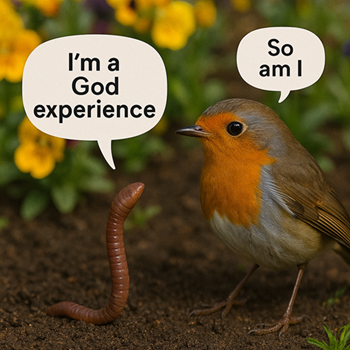
collision-web that grounds reality. 9.2 The Earthworm and the Robin
9.3 The Supermarket as Quantum Field of God-Events Finn’s
supermarket analogy can be repurposed: ·
Products, customers, currency, and transactions
are all quantised units. ·
Every purchase is a discrete event
aligning multiple constraints: desire, price, availability, social norms. This
environment demonstrates that real life occurs only because everything is
decided and quantised. Translating: Every
item and person in the supermarket is a localised UP-node. 9.3 The Human as Diagnostic God-Interface A human
being is distinguished by its diagnostic capacity: ·
It can model other emergents
(e.g. ecosystems, societies). ·
It can simulate alternative constraint
configurations (science, ethics, art). ·
It can alter constraints (technology, law,
culture). Thus,
humans function as meta-procedural nodes: the UP examining and
re-programming itself. This is why Finn casts the druid Finn as “diagnostic
iteration”—a localised God-agent whose task is to name, analyse, and,
where necessary, re-tune constraints. 10. Systematic Summary We can
now compress the whole doctrine into a series of formal claims: 1. Monism: There is
only one ultimate entity (as means): the Universal Procedure (UP),
which is rule-governed, iterative action. 2. Emergence: An emergent
is a relatively stable, identifiable pattern of UP-iteration, defined by a
specific constraint envelope. 3. Localisation: Each
emergent is UP-in-this-mode, i.e. a localised God-execution. No
emergent is ontologically independent of the UP, nor is it made of any other
stuff. 4. Consciousness: o Baseline
consciousness (cit) is
inherent wherever there is feedback-sensitive iteration. o Each
emergent carries such feedback and thus yields a consciousness bite. 5. Divine
Mind: The sum of all consciousness bites—across particles,
organisms, and systems—constitutes God’s consciousness stream, with no
remainder outside this totality. 6. Identity: Identity
is the address of a constraint profile within the UP; selfhood is a high-order addressing mechanism. 7. Goodness: Every
emergent is good at source (simply by existing) as a
faithful UP-execution; local harms are conflicts between constraint systems,
not metaphysical evil. 8. Error: Illusion
and delusion are mis-modelled local states within otherwise valid
UP-execution; they are ontologically real but functionally defective. 9. Ethics
and Practice: o Ethical
work = human,
thus artificial constraint-engineering to
soften destructive collisions and enhance mutually supportive patterns. o Spiritual
insight = recognising oneself as localised UP, i.e. as
God-in-a-particular-space. To wit: “I am the God experience.” 11. Conclusion “Every
emergent as localised God-in-execution” is not a mystical flourish added to
an otherwise secular ontology. It is the logical consequence of: ·
taking Procedure Monism seriously, like
taking one of n Theisms
seriously. ·
defining realness via identifiability and
quantised interaction, and ·
reinterpreting consciousness as
distributed, interface-bound feedback activity. From this
perspective, the universe is not a theatre in which God occasionally
intervenes. It is God’s own procedural unfolding, pixelated into emergents, each of which is a consciousness bite,
a finite, bounded experience of the UP (i.e. God) by the UP (i.e. God). “Emergence as Divinity”, Vedanta style |