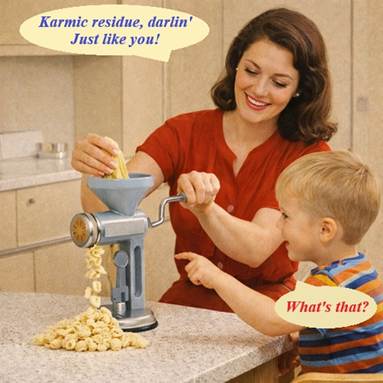
|
No
Origins, Only Residue A Procedural Theory of Karma Without Gods By Bodhangkur
1. “Karmic residue” stripped of mysticism The druid
Finn is not using karma in the moral-retributive sense. So: Karmic
residue = the present-state remainder of past constraint-driven interactions. No
metaphysics. No justice system. No cosmic bookkeeping. In the
image, everything (every
identifiable reality) present
is residue: ·
the gnocchi, ·
the boy, ·
the mother, ·
the dough, ·
the machine, ·
the kitchen, ·
the cultural practice of making pasta. All are
what is left over from prior collisions of constraints. 2. Why the gnocchi are karmic residue The
gnocchi on the table are: ·
compressed history, ·
shaped by the machine’s fixed constraints, ·
determined by the properties of the dough, ·
conditioned by the mother’s hand, timing, and
pressure, ·
downstream of agriculture, milling, water
chemistry, tools, traditions. They
carry no intention and no meaning. This is
karma without mysticism: the shape
of what now exists is the residue of what has already happened. 3. Why the boy is karmic residue The boy
is not “free-standing presence.” ·
genetic inheritance, ·
embryological constraints, ·
developmental conditioning, ·
cultural language acquisition, ·
parental behaviour, ·
historical and economic conditions. Nothing
in him appears ex nihilo. The joke
bites because it collapses the sentimental exception: the child
is not ontologically privileged over the pasta. Both are
outputs of constraint grammars operating on prior inputs. The
difference is not kind. 4. Why the mother is karmic residue The
mother is: ·
the output of her own prior constraints, ·
executing learned procedures, ·
transmitting residues forward. She is
not the origin of the process. She feeds
dough into the machine, In other
words: the
“agent” is itself residue. Agency is
a functional role inside residue, not an exemption from it. 5. Why the dough is karmic residue The dough
is not “raw” in any absolute sense. It is
already the residue of: ·
plant growth, ·
soil chemistry, ·
climate, ·
human cultivation, ·
industrial processing, ·
cultural recipe traditions. It is raw
only relative to the machine. So the input is not primal
chaos. This is
Finn’s machine-relative randomness again: 6. Why the machine itself is karmic residue Even the
machine is residue: ·
of metallurgy, ·
engineering traditions, ·
industrial design, ·
economic production chains, ·
cultural domestic norms, ·
inherited technological grammars. The
machine is not a neutral origin of order. It
enforces constraints, but those constraints are themselves the residue of
earlier constraints. So there is no first machine. 7. The deeper logic of the image The image
quietly asserts a single invariant principle: There is
no ontological clean slate anywhere in the system. So when the mother says: “Karmic residue, Darling. Just like you.” she is
not making a spiritual claim. ·
gnocchi = residue of machine + dough + action ·
boy = residue of biology + culture + history ·
mother = residue of earlier residues ·
machine = residue of technological lineages ·
dough = residue of ecological and industrial
processes Nothing
stands outside the chain. 8. Why the seeming joke works The
humour comes from violating a taboo: ·
we permit calling objects “products of causes,” ·
but we resist calling humans the same. The image
collapses that false hierarchy. The boy
is not less than the gnocchi. Both are procedural
leftovers of the world’s constraint grammar. The
mother’s smile is the cruelty of lucidity: 9. Final compression The image
encodes the druid Finn’s core position: There are
no origins, only residues. The
gnocchi, the child, the mother, the dough, and the machine Making ‘Farfalle’
the philosophic way Karmic
Residue as Function Incompletion The
Constraint-Variance Grammar of Computation From the Rta of Veda to Karmic Residue and Moksha Apurva, Karmic Residue and Rebirth |